Hunter-gatherer, farmer or steppe herder? Your three-wave ancestry
Free · Ancestry report
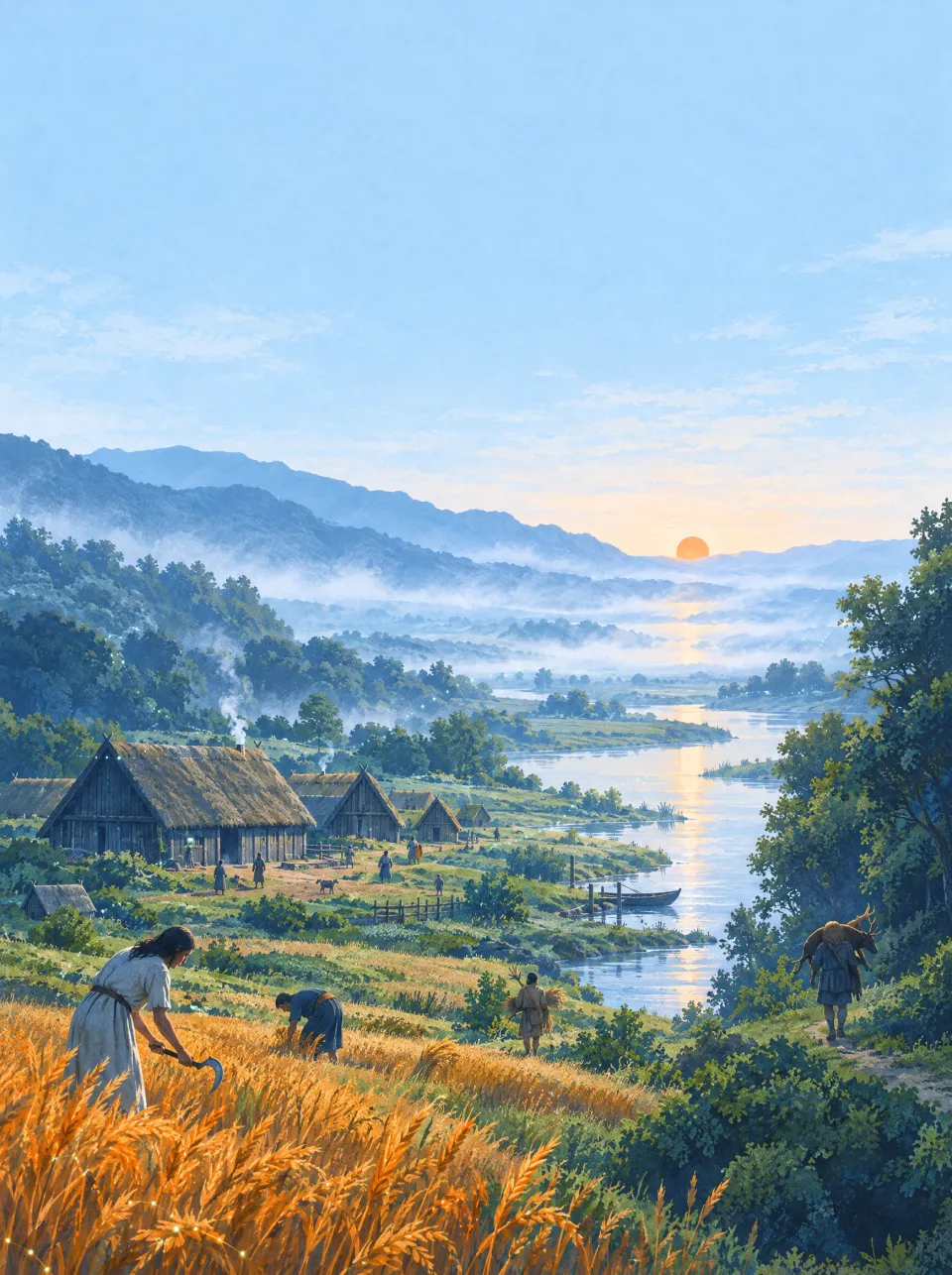
European ancestry comes in three big waves. Hunter-gatherers were there first, farmers from Anatolia and the Fertile Crescent followed, and steppe herders arrived later in the Bronze Age.
This report compares your DNA with seven ancient reference populations and shows which wave your signal resembles most.
It also highlights a few diagnostic markers, such as those for lactase, eye colour and skin tone.
Free: included with every DNA upload.
What this report looks at
- A 48-marker AIM panel calibrated to ancient DNA studies.
- Seven reference populations: Western Hunter-Gatherer, Eastern Hunter-Gatherer, Scandinavian Hunter-Gatherer, Early European Farmer, Western Steppe Herder (Yamnaya), Caucasus Hunter-Gatherer and Iran Neolithic.
- The three-wave model: Western Hunter-Gatherers, Early European Farmers and Western Steppe Herders.
- Notable markers: SLC24A5, SLC45A2, HERC2, LCT, IRF4 and HMGA2 (height).
How it works
Your DNA is compared with ancient reference populations spanning the three waves. Proportions are estimated with non-negative least squares, a standard way to fit a mix of reference populations to your genotypes. Affinity scores are rescaled from 0 to 100 across the panel so they are easy to compare.
The panel coverage is reported with the result. GeneHealth works from the raw data file you already have from 23andMe, AncestryDNA, MyHeritage and other common providers.
Western Steppe Herder, Early European Farmer and Western Hunter-Gatherer are the three headline groups. The others, such as Caucasus Hunter-Gatherer and Iran Neolithic, help explain where some ancestry came from.
What you get
- An explanation of the three waves of migration.
- Your closest ancient population.
- A full breakdown of every ancient population tested.
- Diagnostic SNPs tied to ancient population shifts.
- Notable markers such as lactase, eye colour and skin tone, tied to ancient shifts.
Limitations
- A panel of about 50 markers cannot reproduce full ADMIXTURE or qpAdm analyses. Results are informative at the broad component level, with roughly 5 to 10 percentage points of individual-level uncertainty.
- The model is built for European ancestry. It is less informative for other backgrounds.
- Affinity to an ancient group is a statistical similarity, not proof of descent.
Sources
- Ancient human genomes suggest three ancestral populations for present-day Europeans. Nature, 2014. PubMed PMID 25230663.
- Massive migration from the steppe was a source for Indo-European languages in Europe. Nature, 2015. PubMed PMID 25731166.
- Genome-wide patterns of selection in 230 ancient Eurasians. Nature, 2015. PubMed PMID 26595274.
- The genetic history of Ice Age Europe. Nature, 2016. PubMed PMID 27135931.
- Population genomics of Bronze Age Eurasia. Nature, 2015. PubMed PMID 26062507.
Frequently asked questions
What does 'closest ancient population' mean?
It is the reference population whose allele frequencies fit your genotypes best.
Why is there a margin of uncertainty?
A small marker panel limits precision. The report states it as roughly 5 to 10 percentage points.
How is this different from the Ancient DNA report?
This one focuses on the three-wave model with seven populations and 48 markers. The Ancient DNA report uses 38 markers and eight populations.
Will I see my own ancient ancestors?
No. It shows how your signal resembles groups known from ancient genomes.
Is one wave better than another?
No. They are historical groups, and almost all Europeans carry a mix of them.
Related guides
- Viking DNA test: what it can honestly tell you: You cannot take a DNA test to find out whether you are a Viking. You can measure how closely your DNA resembles people who lived in the Viking Age. Here is what that means, and where the limits are. (7 min read, updated 21 November 2026)
Create a free account · Browse all DNA reports · How to download your raw DNA data