How much Neanderthal DNA do you carry?
Free · Ancestry report
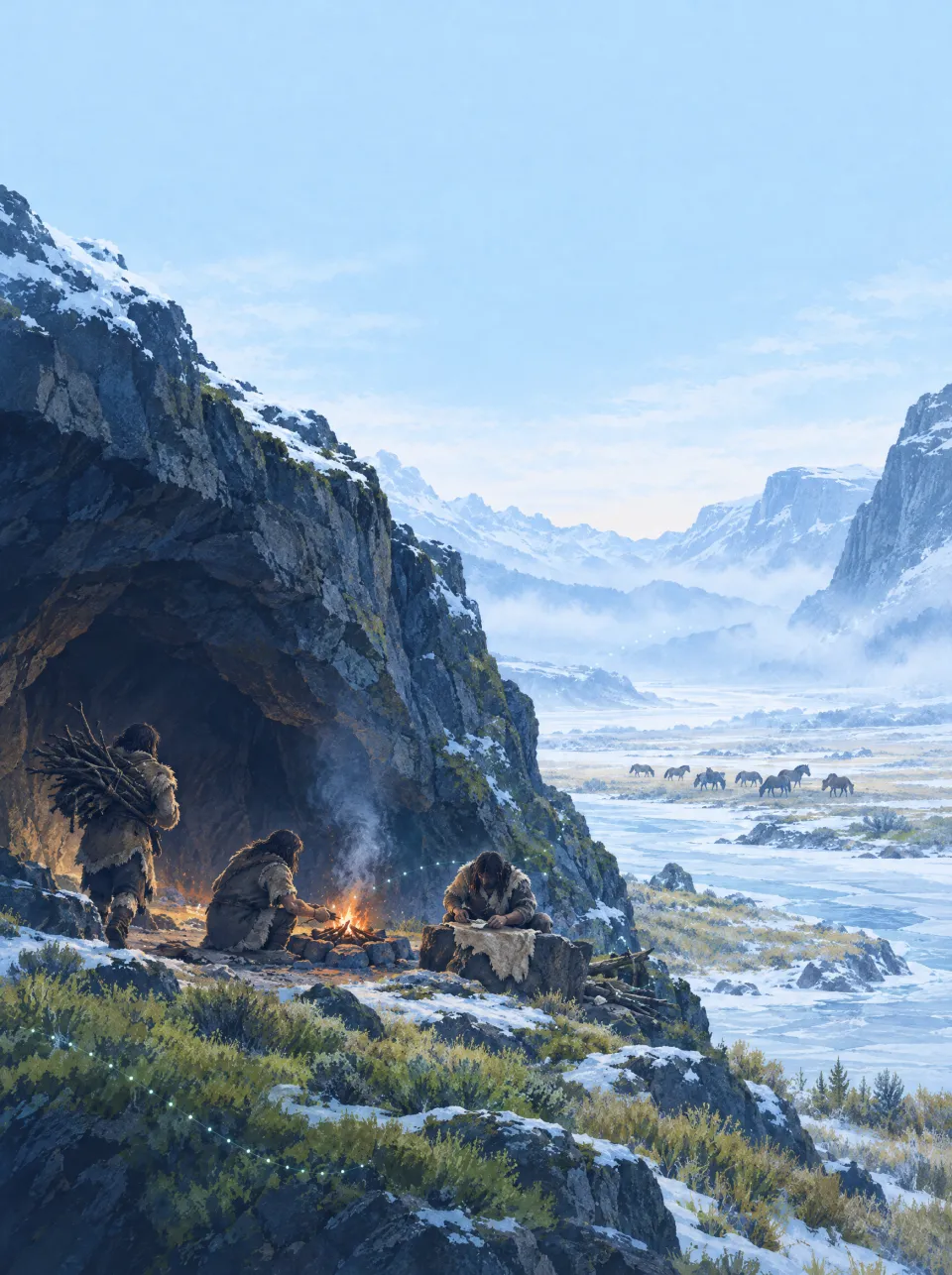
Modern humans and Neanderthals met and had children roughly 50,000 to 60,000 years ago. People with non-African ancestry typically carry between one and four percent Neanderthal DNA.
This report checks 68 well-studied Neanderthal-derived variants in your file and tells you which ones you carry, grouped by the traits they have been linked to.
It is a window into deep history with some practical curiosity attached: pigmentation, immunity, pain sensing and more.
Free: included with every DNA upload.
What this report looks at
- 68 Neanderthal-derived variants (rsIDs) across 53 genes, including BNC2, OAS1, OCA2, SLC16A11, EPAS1 and TRPV1.
- Trait categories: altitude adaptation, cardiovascular, coagulation, connective tissue, immune, metabolism, morphology, neurological, pain, pigmentation, respiratory, sensory and skin structure.
- A summary with variants checked, variants carried, your carry rate and an estimated Neanderthal percentage.
- Variants drawn from published work including Vernot and Akey 2014, Prufer 2014, Sankararaman 2014, Dannemann and Kelso 2017, Simonti 2016 and Zeberg and Paabo 2020.
How it works
The report tests which of the listed markers appear in your file and which allele you carry. Carried variants are then grouped by trait category, and the ones with higher-confidence findings are surfaced first.
The percentage is an estimate, so read it as a rough guide. GeneHealth works from the raw data file you already have from 23andMe, AncestryDNA, MyHeritage and other common providers.
Variants are tied to trait categories such as pigmentation, immunity, pain and metabolism. A Neanderthal allele that shows up in many people is not rare or unusual in itself.
What you get
- A headline estimate of the share of Neanderthal DNA in your genome, with your carry rate.
- The Neanderthal variants you carry that matter most.
- A view of where the Neanderthal in you shows up, by trait category.
- A share-friendly layout for comparing with friends and family.
- The trait categories where your carried variants cluster, such as pigmentation, immune or sensory.
Limitations
- If a marker shows 'Not in your file', your DNA kit did not read that position. It does not mean you lack the variant.
- The percentage is an estimate from a limited marker set, not a whole-genome measurement.
- Trait links are statistical and often small. This report is for curiosity and is not a medical test.
Sources
- Resurrecting surviving Neandertal lineages from modern human genomes. Science, 2014. PubMed PMID 24476670.
- The complete genome sequence of a Neanderthal from the Altai Mountains. Nature, 2014. PubMed PMID 24352235.
- The genomic landscape of Neanderthal ancestry in present-day humans. Nature, 2014. PubMed PMID 24476815.
- The phenotypic legacy of admixture between modern humans and Neandertals. Science, 2016. PubMed PMID 26912863.
- The major genetic risk factor for severe COVID-19 is inherited from Neanderthals. Nature, 2020. PubMed PMID 32998156.
Frequently asked questions
Does everyone carry Neanderthal DNA?
People with non-African ancestry typically carry one to four percent Neanderthal DNA. This report estimates your own share from the markers it can read in your file.
Why does my percentage differ from other sites?
Marker sets and methods differ. This estimate uses a defined list of variants in your file, so numbers are not directly comparable.
Do Neanderthal variants affect my health?
Some have been linked to traits or disease risk in studies. Effects are usually small and context dependent.
What does 'Not in your file' mean?
Your DNA test did not read that position, so the report cannot say either way.
Is Neanderthal DNA good or bad?
Neither by default. Some variants have been linked to traits or disease risk in studies, and many are small effects.
Related guides
- AncestryDNA raw data analysis: what you can learn from your file: Your AncestryDNA kit produced a file of genotypes that you can download and use elsewhere. Here is what is inside, what outside analysis can honestly tell you, and what to check before you upload it. (7 min read, updated 21 November 2026)
- What to do with your raw DNA data: You downloaded a file full of genotypes. Now what? Here are the useful things you can do with it, the risks worth knowing, and a way to choose a service you can trust. (7 min read, updated 21 November 2026)
- Neanderthal DNA percentage: what the number means: Most people whose ancestors lived outside Africa carry a small share of Neanderthal DNA. Here is what that share is, why different tests give different numbers, and what a raw data report can honestly show. (7 min read, updated 21 November 2026)
Create a free account · Browse all DNA reports · How to download your raw DNA data